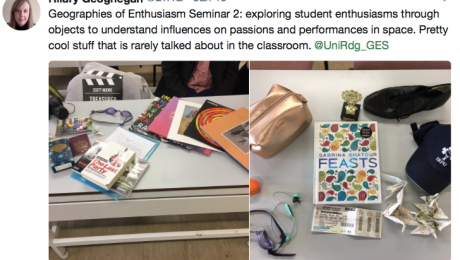
What’s it about? My Geographies of Enthusiasm 3rd year undergraduate module so far…
Whilst the module handbook exists complete with references, I am writing the module week by week. So far, the first four weeks have played out as follows…
Whilst the module handbook exists complete with references, I am writing the module week by week. So far, the first four weeks have played out as follows…
It is with great pleasure that I can now announce the publication of our UKEOF Report. Hurrah! A study on the motivations for ‘citizen scientists’, who volunteer their time to support scientific research, has found that ‘helping wildlife in general’ and ‘contributing to scientific knowledge’ were primary motivations for the hundreds of thousands of volunteers…
Professor Muki Haklay’s recent blog “Securing funding and balancing efforts: a tale of 21 research applications” (see below and Po Ve Sham – Muki Haklay’s personal blog) makes for some refreshing reading. His group has secured €7million in the last 4 months or so, but it wasn’t without an awful lot of work – including unsuccessful…
13.30 Friday 24th April 2015 (This blogpost has been in the draft file – Raul’s post reminded me…) Since my last blogpost, I was struck down with a virus. A nasty one that has left me with hearing loss in my right ear. I started the break for Easter with a few days holiday in Ireland.…
At last a blog post to let you know about a quick 10 minute survey I have created with Alison Dyke (York) and Glyn Everett (UWE) on motivations around citizen science. Citizen science is now an established means of collecting, analysing and responding to data about the natural environment. However, in order to fulfil its…

Originally posted on Progressive Geographies:
Last year Rob Kitchin had a short post on his blog ‘The View from the Blue House’: Over the past couple of years I’ve been getting more and more invites to do work that extends beyond my usual day to day work. This last week has bought it home to me…
Brick Walls: Diary of a SAGES Athena SWAN Lead by Hilary Geoghegan Posted on June 19, 2015by louisejones here: http://blogs.reading.ac.uk/sages-advice-fieldwork-gender-careers/2015/06/19/brick-walls-diary-of-a-sages-athena-swan-lead-by-hilary-geoghegan/ Wednesday 10th June I receive a forwarded email from a SAGES colleague with a link to a Guardian article “Nobel scientist, Tim Hunt: female scientists cause trouble for men in labs”. It was accompanied by the message ‘sigh!’ http://www.theguardian.com/uk-news/2015/jun/10/nobel-scientist-tim-hunt-female-scientists-cause-trouble-for-men-in-labs …
Reblogged from SAGE(S) Advice: Fieldwork, Gender & Careers Posted on May 29, 2015by louisejones On 29th April 2015, 50 academics, researchers, students and invited guests of the School of Archaeology, Geography and Environmental Science gathered to share their experiences and perspectives on the theme of ‘Gender and Fieldwork’. Fieldwork can be broadly defined as the work we do…

The small things that make up ‘academic life’… Sort out VAT on expense claim Organise marking for seminar reviews Review two papers Organise interview transcription Sort out consultancy claim Book student to improve wordpress site Re-draft sections of Athena SWAN application Re-draft paper revisions with co-authors Write dept blogpost Send out email about dissertation prize…

It’s been a busy 2015 and today I just needed an hour or two to clear my mind and refresh my thinking on what needs to happen before the end of term. I decided getting outside and doing some gardening might be the answer – getting a planty perspective (see work by Atchison and Head…

Following a superb meeting on citizen science last week – here are a couple of events you might be interested in… British Ecological Society Citizen Science special interest group’s events in May The two events are quite different in structure and purpose – but both linked to citizen science (obviously!). Feel free to come along…
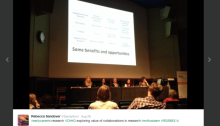
Risk is both motivating and paralyzing. On the one hand taking risks can move us forward as researchers, advancing our knowledge of the world. On the other hand the before, after and moment of risk-taking can stop us in our tracks, unable to move, respond or get on with life. I’ve experienced both of these…
Earlier this week, I got this email: Do you mind me asking – how do you find the confidence/enthusiasm to keep working when people around you don’t necessarily support/encourage you? How did you find that inner confidence to go for it? I was flattered and shocked. On the one hand, it is great to be…

I completed my lecture-based teaching last term so I could throw myself into reading, writing, re-drafting this term. My name is Hilary and I think I’m addicted to academia. I was eating, drinking and sleeping ideas, references and cross-disciplinary inspiration. I’ve identified 5 signs you might be addicted to academia: 1. You wake up and…

 The Culture of Enthusiasm